

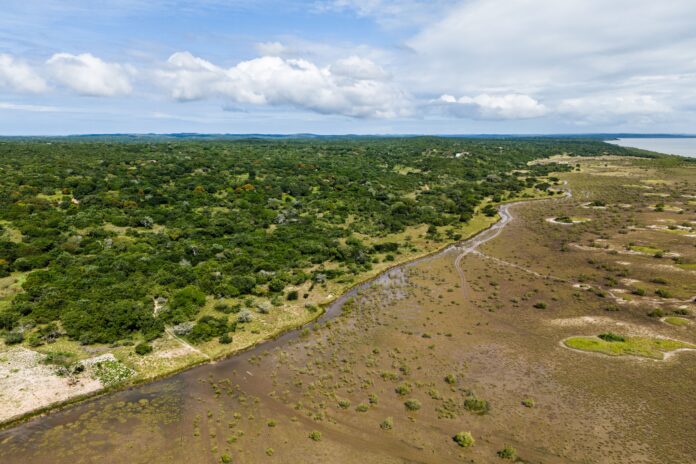
The TUI Care Foundation has launched TUI Forest Mozambique, a new conservation initiative which restores degraded mangrove habitats and supports sustainable development for communities living adjacent to the Maputo National Park – a globally important biodiversity area of more than 1,700 square kilometres in southern Mozambique.
Mangrove forests are essential coastal ecosystems that protect shorelines from erosion, provide nursery habitat for fish and marine species, store carbon and support local livelihoods. However, decades of unsustainable land use and limited alternative income opportunities have weakened the resilience of the Maputo National Park’s mangroves and reduced community engagement in conservation.
TUI Forest Mozambique tackles these challenges by restoring more than 150 hectares of degraded mangrove habitat through the planting of over 500,000 mangrove trees. The project brings together the TUI Care Foundation, local communities and Peace Parks Foundation, whose expertise in landscape-scale conservation and community engagement is guiding the restoration and sustainability efforts.
In addition to ecological restoration, the project supports local communities living around the national park by strengthening environmental education and expanding nature-based tourism opportunities. Teachers and environmental club leaders from schools in the park’s buffer zone will receive training and resources in conservation practices at the Community Training Centre in the Park, whilst upgrades to school facilities in one of the most marginalised communities in the southwest buffer zone, will improve learning environments and broaden access to environmental learning for young people.
To help local families benefit from the park’s natural assets, TUI Forest Mozambique is also creating four community-based enterprises in the coastal areas of Santa Maria and Ponta do Ouro. These small nature-based tourism activities will help diversify income sources, strengthen economic participation, and encourage stewardship of the surrounding ecosystems. Improvements in tourism infrastructure are planned, including the installation of a 200-metre mangrove walkway with interpretive signage and visitor facilities to foster learning and appreciation of the mangrove system.
The initiative reflects the Foundation’s commitment to large-scale conservation within the TUI Forests programme, which has already helped plant five million trees globally and supports community-driven forest restoration. By coupling ecosystem restoration with job creation, environmental education and visitor experiences, TUI Forest Mozambique aims to strengthen the long-term resilience of Maputo National Park and the communities that depend on it.
TUI Forest Mozambique is supported by the Tourism for Development Fund, which was launched by the TUI Care Foundation in collaboration with UN Tourism to support the sustainable development of tourism in Least Developed Countries (LDCs). Mobilising at least €10 million by 2030, the Fund supports projects designed to increase the capacity of destination communities, and which will improve their livelihoods, conserve and regenerate nature, and create market-based solutions that benefit communities in tourism destinations. Alongside Mozambique, targeted LDCs include Cambodia, Laos, Rwanda, Senegal, The Gambia, Tanzania, Uganda, and Zambia.
The TUI Care Foundation’s ‘Forest February’ is a month of activities dedicated to reforestation. Through a series of project launches and educational activities, it emphasises the importance of community-managed reforestation solutions and sustainable agro-forestry tourism practices to safeguard forest ecosystems for local communities and generations to come.