
The head of TUI Cruises has called for an acceleration in the production of greener ship fuel in order to support the cruise industry’s transition to a more sustainable future.
Wybcke Meier, CEO of TUI Cruises, said: “Cruise lines are long-term industrial partners. Every vessel ordered here in Europe strengthens local supply chains, drives environmental innovation, and supports European jobs. We are consistently focusing on energy efficiency and have equipped our ships with state-of-the-art propulsion technologies. Now to ensure that the green transition does not become a burden, the production of low emission fuels needs to be ramped up.”
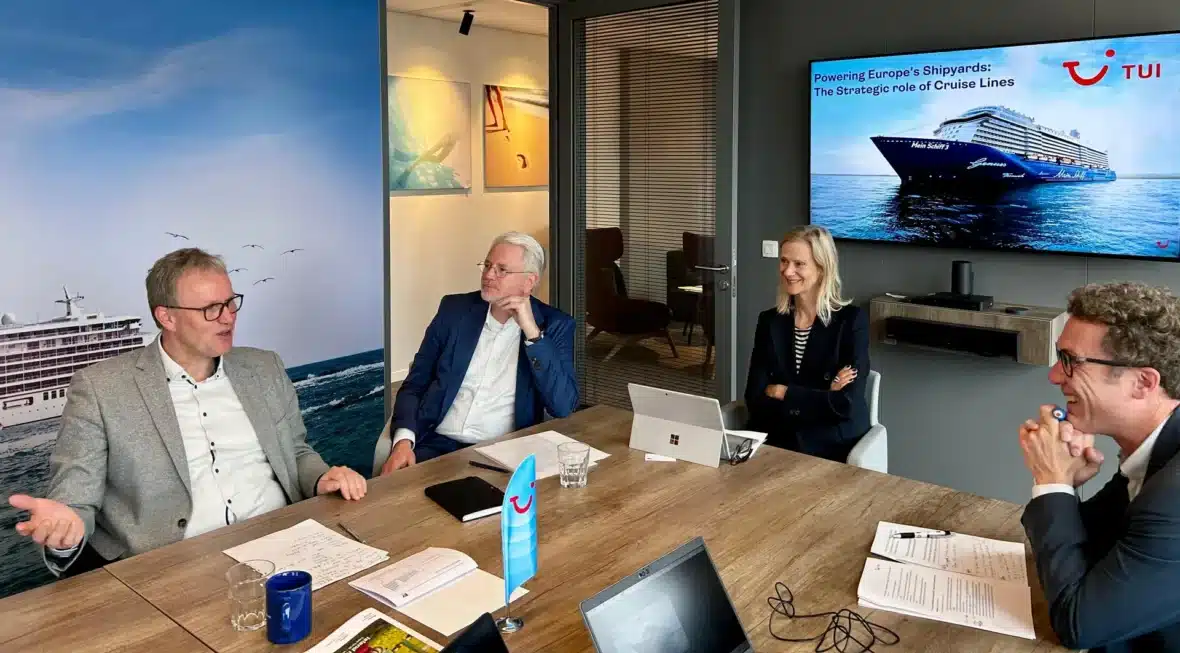
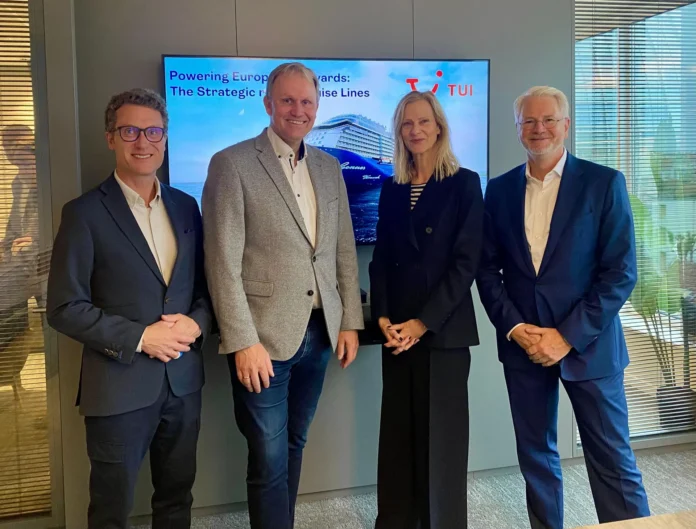
Against the backdrop of the UN Ocean Conference in Nice—where the EU presented its long-anticipated Oceans Pact—TUI Group hosted a high-level Policy Breakfast at its Brussels office.
Under the theme “Powering Europe’s Shipyards”, the event brought together EU policymakers, shipbuilding and cruise industry leaders, as well as regional stakeholders to explore how Europe’s cruise sector can play a pivotal role in delivering the ambitions of the upcoming EU Maritime Industrial Strategy and the Sustainable Transport Investment Plan (STIP). From innovation and decarbonisation to economic resilience, the sector is positioned as both an industrial powerhouse and an innovator providing solutions for the green transition.
TUI itself has set a target to reduce cruise GHG emissions by 27.5% by 2030, compared to 2019—a goal validated by the Science Based Targets initiative (SBTi). According to Ms Meier, some operations could even reach carbon neutrality ahead of 2050.
To meet these goals, TUI’s cruise brands are deploying a mix of measures, including onshore power connections, retrofitting, and the use of alternative fuels such as bio-LNG and green methanol. Notably, Mein Schiff 7, built in Finland, is the world’s first methanol-ready cruise ship, marking a significant technological step.
Yet while vessels are ready for shoreside electricity, many ports are not. TUI has increased port calls using onshore power by 38% for Mein Schiff and Hapag-Lloyd, but infrastructure must keep pace. A forthcoming EU Port Strategy is expected to address these gaps.
The discussion also pointed to the STIP as a vehicle to mobilise investment into green infrastructure and sustainable fuels. Experts argued that existing regulatory frameworks—such as the EU Emissions Trading System (ETS)—should be retooled to support industrial decarbonisation by reinvesting revenues into European-made technologies.
MEP Jens Gieseke emphasised the broader legislative context:
“The Net Zero Industrial Act will play a crucial role in Germany’s and Europe’s industrial heartland, to foster innovation, ramp up the production of alternative fuels and unlock new funding schemes to fulfil these goals.”