
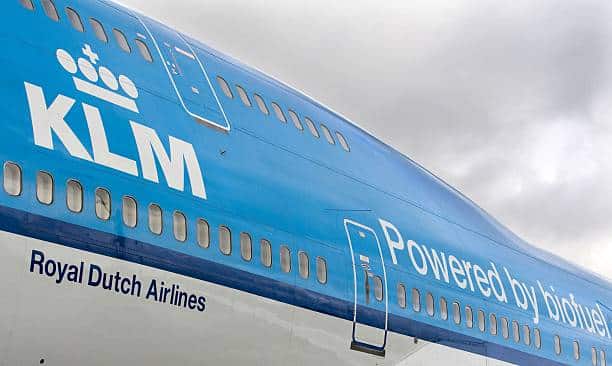
KLM has given a broad welcome to the European Commission’s initiative to improve access to alternative aviation fuels.
With the publication of the Sustainable Transport Investment Plan (STIP), last week, the Commission is taking an important step toward scaling up the production of alternative aviation fuels (SAF and eSAF), the Dutch carrier said. According to KLM, this marks a key milestone in accelerating the sustainability transition of the aviation sector in Europe.
Aviation group, the International Air Transport Association (IATA) last week welcomed STIP, but said it doesn’t go far enough in its current form. IATA Welcomes EU’s Sustainable Transport Plan, but Stresses More Needs to be Done | ittn.ie
But, here’s what KLM said in its welcoming of the new initiative: “KLM views the STIP as an opportunity to stimulate the development of alternative fuels, increase production within Europe, and reduce costs. It is now essential that the announced measures be implemented to make SAF more affordable and to strengthen the competitiveness of the European aviation industry.
“The availability of affordable alternative fuels is crucial to achieving the 2050 climate goals. KLM strongly supports expanding the use of SAF and endorses the European SAF mandate, which requires a 2% SAF blend from 2025, increasing to 6% by 2030 and 20% by 2035. However, it is crucial that production is scaled up quickly and that SAF becomes more affordable.
Important boost for production and affordability
“The STIP includes concrete measures to accelerate the production of SAF and eSAF in Europe, lower costs, and stimulate investment in cleaner technologies and infrastructure. The plan also recognizes the challenges KLM currently faces in the European market, including SAF availability and affordability. KLM welcomes the European Commission’s initiative to allocate ETS revenues to help decarbonize aviation, as well as its call for EU Member States to contribute. This approach provides producers with greater certainty and increases the likelihood of rapidly expanding production capacity.
KLM as one of the world’s largest SAF buyers
“As one of the world’s largest purchasers of SAF, KLM has been investing for years in the development and use of alternative fuels. Together with partners such as SkyNRG and Neste, KLM is working to scale up SAF production in the Netherlands and across Europe. In addition, KLM is a co-founder of Project Skypower, an initiative to further expand eSAF production. The Netherlands has a strong starting position to take a leading role in Europe, thanks in part to the Port of Rotterdam and the presence of innovative production and logistics companies.
A level playing field is essential
“KLM emphasises that the measures announced in the STIP must help ensure a level playing field so that the global competitiveness of European airlines is maintained.
“With the publication of the STIP, and with the right investments from the EU and its member states, important progress is being made toward cleaner and more future-proof aviation.
Lower CO₂ Emissions
“Alternative aviation fuels are not derived from fossil sources but are produced from waste materials, such as used cooking oil. The production process results in significantly lower CO₂ emissions. While SAF emits roughly the same amount of CO₂ during flight, its total life-cycle carbon footprint (from production to combustion) is at least 65% lower than that of conventional kerosene.”