

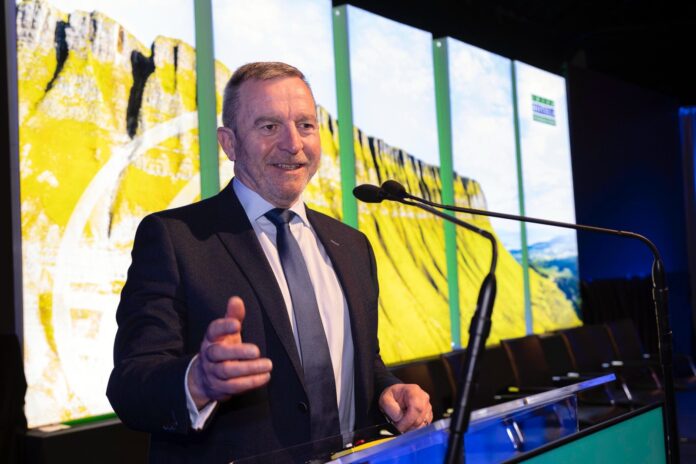
Speaking at the Irish Hotels Federation’s (IHF) Annual Conference today, IHF Chief Executive Paul Gallagher warned Ireland’s tourism infrastructure is at a critical crossroads.
He noted that a combination of prohibitive construction costs and systemic planning delays is currently preventing thousands of essential bedrooms from coming online, jeopardising the industry’s future growth.
New industry research conducted by the IHF reveals that while hoteliers across the country are eager to expand their footprint, a significant portion of these projects are stalling due to persistent development barriers. Of those hotel businesses planning to invest in additional guestrooms, whether through the expansion of existing properties or the development of new builds, 45% reported that their projects are currently on hold.
The IHF warns that these barriers pose a serious threat to the long-term competitiveness of Irish tourism. The shortage of available rooms is increasingly evident during peak periods, where occupancy levels regularly reach “compression” peaks of 90–95%, limiting the country’s ability to host international visitors and accommodate domestic demand.
Key Research Findings on Investment Barriers:
- Construction Viability: 88% cited the gap between per-room build costs and return on investment (ROI) as a major (46%) or significant (42%) barrier to progression
- Planning Process: 72% identified the planning approval process, characterised by delays and uncertainty, as a major (31%) or significant (41%) hurdle
- Access to Finance: 54% identified the difficulty in securing viable financing as a major (16%) or significant (38%) barrier to new development
- Utility infrastructure: 36% cited delays in water or electricity connections as a major (16%) or significant (20%) impediment to completing projects
Mr Gallagher stated: “The long-term success of Irish tourism depends on our ability to offer high-quality, approved accommodation across every county. While the ambition to grow is evident throughout our sector, many hoteliers are currently facing significant hurdles that make it difficult to bring new projects to fruition. Between the rising cost of construction and a planning system that often lacks the necessary speed and certainty, the path to expanding our room capacity has become increasingly complex.”

“To meet the goals set out in the Government’s new tourism policy, we must ensure that the practical environment for investment is supportive. By addressing these structural bottlenecks, we can unlock the potential of our regional heartlands and ensure Ireland remains a premier, competitive destination for years to come.”
A Call for Targeted Policy Measures
The IHF is urging the Government to implement strategic interventions to unlock the development pipeline. This is particularly vital in regional locations where tourism growth is currently capped by limited room availability. Key measures sought by the Federation include:
- Streamlined Planning: Implementing faster, more predictable approval processes for tourism accommodation, including specific incentives to de-risk regional projects.
- Financial Support: Facilitating access to low-cost financing or tax-based incentives to support the viability of new builds and the expansion and essential upgrading of existing properties.
- Stock Protection: Ensuring that the use of hotel stock for non-tourism purposes is balanced so as not to compromise the long-term sustainability of the sector or local economies.