
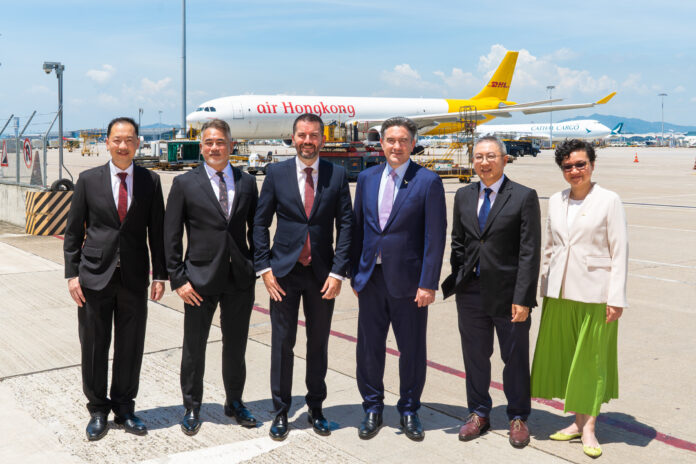
Logistics giant DHL Express has announced a green fuel partnership with Cathay Group – which owns Cathay Pacific and Air Hong Kong – to drive sustainable aviation fuel (SAF) production and update in Asia.
The new agreement underscores both parties’ commitment to lower-carbon air logistics and driving the production and use of SAF for the air cargo sector.
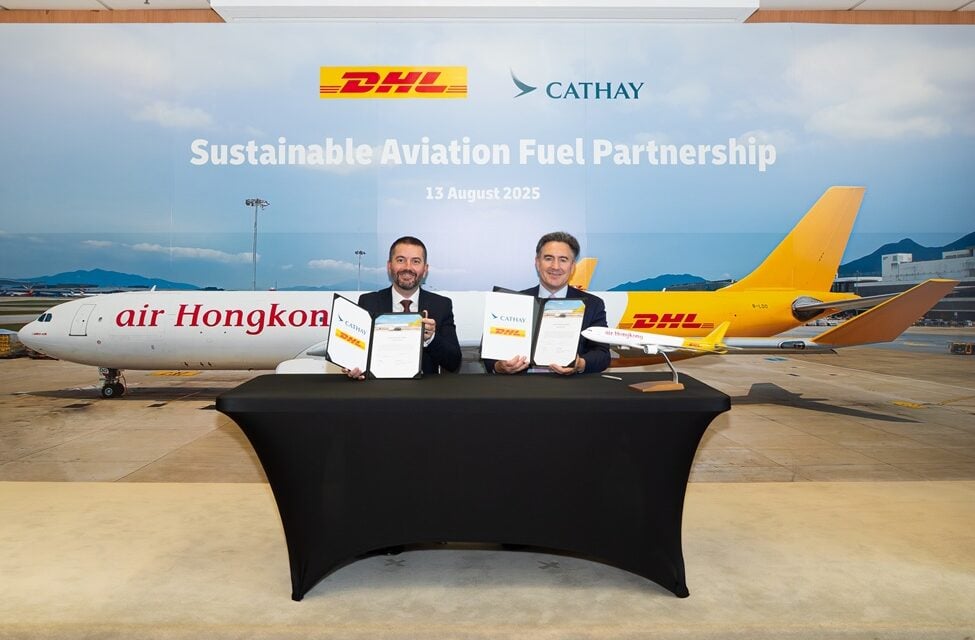
Under the agreement, Cathay will supply DHL Express with 2,400 tonnes of SAF for international flights departing from three airports in Asia namely Seoul Incheon International Airport, Tokyo Narita International Airport, and Singapore Changi Airport. These flights are operated by Air Hong Kong, a wholly owned subsidiary of the Cathay Group, which principally operates express cargo services for DHL Express.
Continuing through 2025, the partnership is expected to reduce lifecycle greenhouse gas emissions by approximately 7,190 tonnes — equivalent to the emissions of over 100 flights from Hong Kong to Singapore with an Airbus 330 freighter.
DHL Express Senior Vice President for Network Operations & Aviation – Asia Pacific Peter Bardens said: “Sustainable aviation fuel currently accounts for less than 1% of the total global jet fuel consumption, yet air transport is one of our biggest sources of greenhouse gas emissions. Our decision to expand our SAF usage in Asia with Cathay is another important step that we have taken to drive momentum in SAF production and demand.
“DHL Express is at the forefront of SAF adoption, and we look forward to seeing more partners and customers join us on this journey to build a more robust SAF ecosystem in Asia. Our continued investment in this area aligns with DHL Group’s Strategy 2030, which recognises ‘green logistics of choice’ as one of the four bottom lines.”
Cathay Director Cargo Tom Owen said: “This partnership marks the first SAF uplift on Air Hong Kong flights, a key milestone for Cathay as we continue to expand the SAF usage across our global network. SAF remains a core pillar of our strategy to address our carbon emissions, and collaboration is essential to scaling its use. We are excited to be working with like-minded partners like DHL Express to make SAF more accessible and scalable, particularly in Asia.”